
Dumpster sizes: 10, 15, 20, 30, and 40 yard
A simple guide to picking a roll-off. Exact dimensions vary by company, so confirm the footprint and weight limit with the hauler.
Use this as a planning guide. Overfilling, or going over the weight limit, usually costs extra. Heavy material often needs a smaller box.
| Size | Good for | Rough footprint | Notes |
|---|---|---|---|
| 10 yard | A small cleanout, a few pieces of furniture, a small bath remodel, or a tight driveway | Often around 12–14 ft long, about 8 ft wide, and roughly 3.5–4 ft tall | A common choice when the load will be heavy, such as dirt or concrete, if the company offers a heavy-debris box |
| 15 yard | A garage cleanout, a small roof job, or a mid-size household junk pile | Similar length to a mid-size box, a bit taller than a 10-yard | Some companies advertise 15-yard containers as a standard residential size |
| 20 yard | A roof tear-off, a larger remodel, or a whole-home decluttering | Often in the 16–22 ft long range, about 8 ft wide, around 5–6 ft tall | A frequent starting size when you are not sure and the debris is mixed household or construction material |
| 30 yard | Bigger construction, a commercial cleanout, or a large volume job | Longer and/or taller than a 20-yard; still usually about 8 ft wide | Needs a clearer drop zone. Not always allowed for very heavy debris |
| 40 yard | Major demolition or large commercial volume | Among the largest roll-offs, often around 22 ft long and up to about 8 ft tall | Needs the most space. Usually the wrong pick for dirt, brick, or concrete |
Weight matters as much as size
Roofing shingles, dirt, caliche, concrete, and brick are heavy. A smaller container can be the right call, so you do not go over the included weight.
Posted Midland examples show included weight in the neighborhood of 1.5 to 3 tons, depending on size, with a fee for each extra ton. See the pricing guide.
Space the truck needs
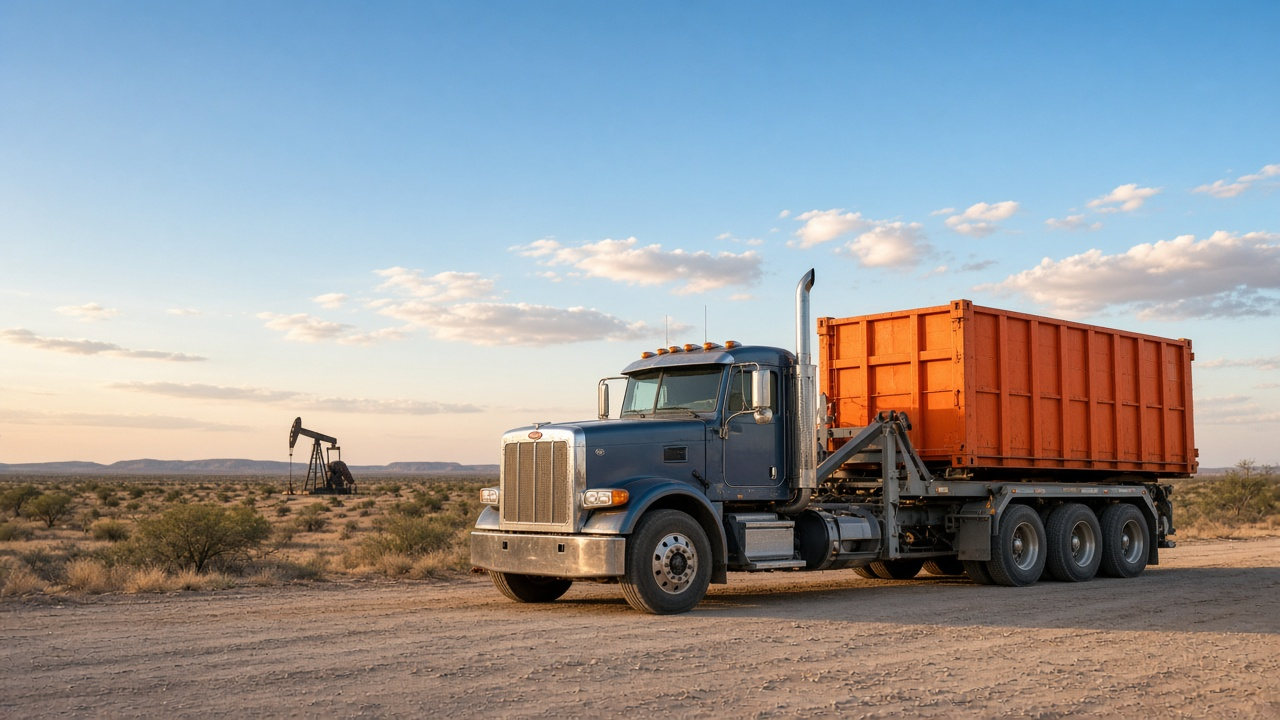
The truck has to roll the container off the back, so it needs a fairly straight approach.
Dumpsters.com, describing deliveries in the Houston area, says its drivers typically need:
- About 60 feet of space
- 23 to 25 feet of vertical clearance
That is a useful planning number, not a city rule.
Watch for low lines, tree limbs, and tight turns. Tell the provider if the drop is on caliche, a soft lease road, or a steep drive.
Source: Dumpsters.com Pearland service page, clearance note.
Need a hand with a dumpster?
Tell us the city, the job, and when you need it. We’ll connect you with a local hauler for a free quote.